NYC’s AI Training Grants Should Reward Less Rework
Gleb Tsipursky on a 30-day rework ledger for New York small businesses and what the city’s AI training grants should reward.
Consider a Queens restaurant that uses AI to draft a catering quote. The first version arrives in three minutes instead of fifteen. The manager then discovers a missed dietary restriction, rewrites the order, and calls the customer to straighten it out. The software appears to have saved twelve minutes. The business may have lost time by the time the corrected quote reaches the customer.
That example is hypothetical, but the accounting problem is familiar. An owner who measures only the first draft will miss the work that returns. A draft, reply, quote, inventory description, or customer-service answer creates value when the finished job is correct and the customer can use it.
New York City has a timely opportunity to make this distinction. Its AI Unlocked training initiative introduces small businesses to AI skills and directs them toward financing. The city's Customized Training Grant Program reimburses up to 60 percent of eligible training costs for qualifying businesses. Applicants identify business problems and the training intended to solve them. The program already ties training to employee development and requires wage increases after completion.
Those are sensible foundations. My proposal is to make another outcome explicit for AI-related training: how much costly rework disappears once employees actually use the technology. Owners could document that with a simple 30-day ledger before choosing another tool, buying more training, or claiming a grant succeeded.
Faster Drafts Can Conceal Slower Work
In Gallup's October 2026 workplace findings, 63 percent of employees who had used AI at work said it helped them complete tasks faster. Only 46 percent said it improved the quality of their work. These are workers' own assessments, rather than measurements by employers. The gap nevertheless gives owners a good question to investigate: faster at which stage, and with what consequences for the completed job?
Research also gives us reason to take the opportunity seriously. A peer-reviewed study of 5,172 customer-support agents found that an AI assistant increased issues resolved per hour by about 15 percent on average. Less experienced staff saw especially strong gains, although results varied by skill level. That evidence supports testing AI in actual workflows. It cannot tell a Brooklyn storefront or Manhattan professional firm what it will save on its own orders, quotes, or client files.
Nor does a shorter task automatically free up an equivalent block of billable time. In a field experiment across 66 companies, workers who used an integrated AI tool spent less time on email, but researchers found no broad reshuffling of their other tasks from providing the tool alone. An owner still needs to decide where the recovered time goes and whether customers receive better service.
Run a 30-Day Rework Ledger
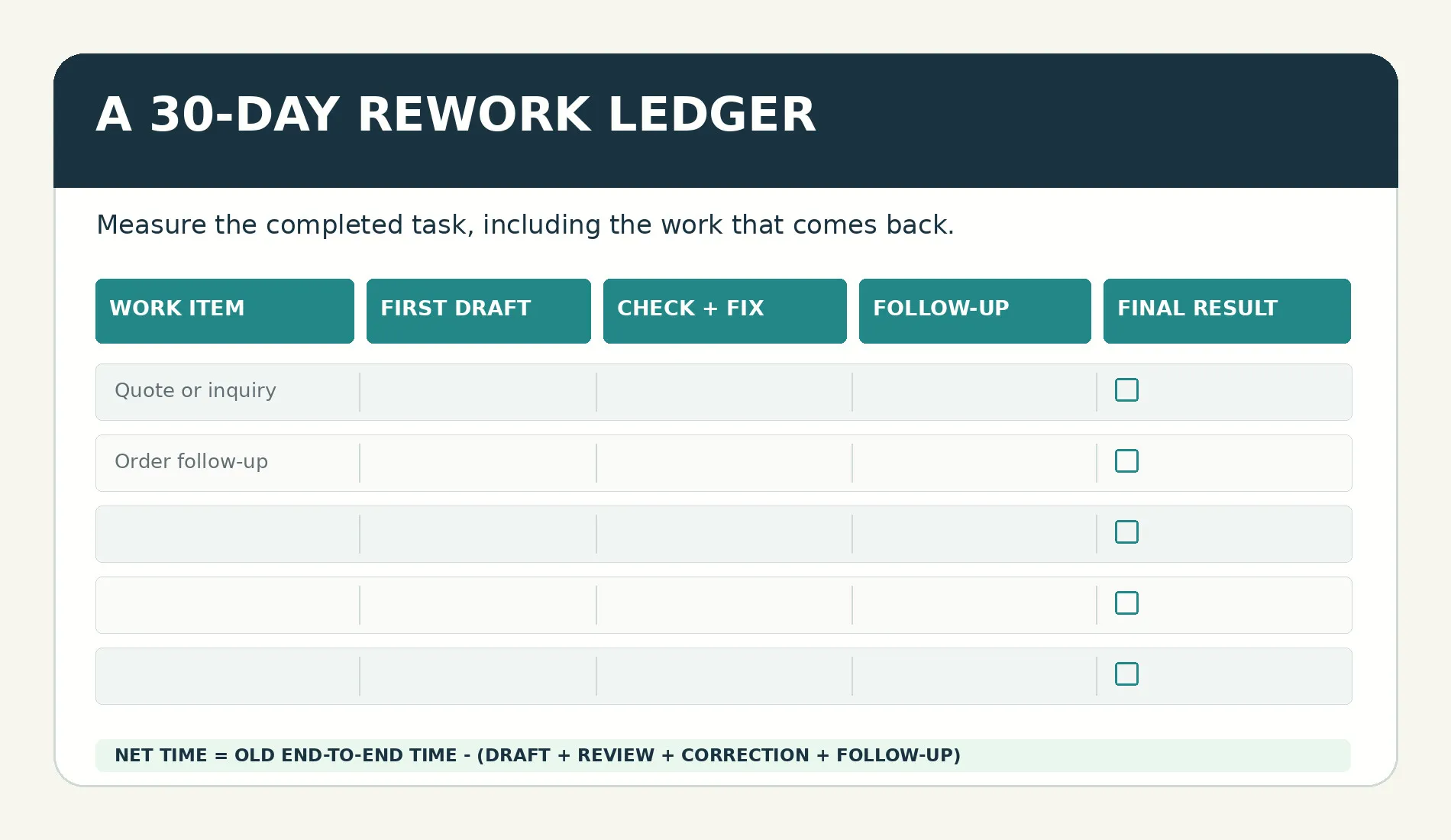
A useful ledger can fit in an ordinary spreadsheet. Choose one repetitive job with a clear finish line: preparing catering estimates, answering common customer inquiries, drafting appointment reminders, checking purchase-order descriptions, or assembling an initial client-update email. Avoid comparing entirely different tasks or unusually busy days.
For the first week, record a baseline without the new AI workflow. Note how many minutes the job takes from assignment to usable result, how many corrections are required, and how often the customer or next employee sends it back. Include the time needed to catch a mistake, not just to repair it. Do not place customer-sensitive information into a tool that the business has not approved for that purpose.
In weeks two and three, train the employees who perform the task and run the same type of jobs with AI assistance. For every item, enter the task, employee or role, first-draft minutes, review minutes, correction minutes, repeat-contact minutes, and whether the result was accepted the first time. Log mistakes discovered after delivery, too. Have staff identify what caused them: bad input, an unreliable AI answer, a vague instruction, or an ordinary process problem.
Here is a deliberately simple illustration. Suppose a salon takes eighteen minutes to handle a routine appointment inquiry manually. With AI, the draft takes three minutes, staff verification takes five, and corrections take four. One in five inquiries needs an additional ten-minute customer exchange, adding an average of two minutes per inquiry. Total AI-assisted time is fourteen minutes, a net saving of four. The first-draft number alone would have suggested a fifteen-minute saving. These figures are illustrative, not measured results from a real salon.
In week four, compare like with like. Calculate net minutes saved per completed job as the old end-to-end time minus drafting, checking, correcting, and follow-up under the new process. Track defects or customer callbacks per 100 completed jobs, not just raw counts, so a busier week does not make performance look worse. Separate routine requests from complex exceptions. Multiply any credible time saving by actual volume and labor cost, and subtract the software and training costs attributable to the pilot.
Most important, ask the employees doing the repair work whether the ledger captures it all. Gallup's same 2026 research found that 52 percent of surveyed workers wanted more influence over the adoption of new technology. They often know which shortcut merely transfers effort to a colleague on the next shift. Their feedback can change the workflow before bad habits become permanent.
Pay for Competence and Customer Outcomes
The city's program already recognizes that useful training should solve a business problem. Its published examples include a Bronx food distributor, Fancy Foods, which trained nineteen employees, and an insurance brokerage that trained staff on new systems. These are examples of the existing training program, not claims that either company used AI or the ledger proposed here.
For AI-related training proposals, the city could build on those expectations in three practical ways. First, require applicants to name one or two measurable jobs they want to improve and establish a short baseline. Second, let a 30-day post-training record show net time saved, error and repeat-contact rates, and any changes in employee skill. Third, give weight to sustained customer outcomes, such as fewer corrected invoices, fewer replacement orders, or faster accurate responses, alongside the program's existing employee-development and wage requirements.
This would avoid rewarding a vendor demonstration, an employee attendance sheet, or a screenshot of a fast AI answer as if it were a business result. It would also give a smaller company permission to conclude that AI does not help with a particular task. Stopping an unproductive use case can be a good outcome when it saves an owner more expense.
The burden should stay proportionate. Many small firms lack dedicated analysts. A five-column monthly summary and a small sample of completed jobs can tell a credible story without requiring a consulting project. The city's own small-business reform agenda emphasizes reducing unnecessary paperwork; grant reporting should follow that same principle. Businesses with fewer than five employees can explore the training program's consortium option, rather than assuming its minimum training threshold rules them out.
The proposed test also fits a broader lesson from the National Institute of Standards and Technology's AI risk framework: organizations need measures of performance and ways to manage errors after a system goes into use. A business owner can apply that principle without becoming a technical expert. Check what leaves the business, record what comes back, and change the process when the errors cost more than the shortcut saves.
New York should help businesses build lasting workplace AI adoption. But the public return should appear in completed orders, competent employees, sound customer relationships, and genuinely recovered staff time. The most useful number in an AI grant application may be the amount of work nobody has to do twice.

Dr. Gleb Tsipursky, courtesy of the author.
About the author: Gleb Tsipursky, PhD, is a behavioral scientist, CEO of Disaster Avoidance Experts, and author of The Psychology of AI Adoption at Work: From Resistance to Results (Georgetown University Press, 2026) https://disasteravoidanceexperts.com/aibook. He advises organizations on translating AI investments into measurable improvements in employee performance, customer service, and organizational change, drawing on more than 20 years of consulting and coaching experience.
LinkedIn: Dr. Gleb Tsipursky
Website: Disaster Avoidance Experts
Disclosure: The author leads a consultancy that advises organizations on AI adoption.